If you use credit cards from banks like HDFC Bank, Axis Bank, ICICI Bank, or State Bank of India, among others, one key factor that affects your credit score is:
👉 How much of your total credit limit do you use
This is called your Credit Utilization Ratio—and it becomes even more important when you have multiple cards.
📌 What is Credit Utilization?
It is the percentage of your available credit that you are using.
Formula:
👉 (Total Used Amount ÷ Total Credit Limit) × 100
🟢 Simple Example (Single Card)
|
Credit Limit |
Spending |
Utilization |
|
₹1,00,000 |
₹20,000 |
20% ✅ |
|
₹1,00,000 |
₹50,000 |
50% ⚠️ |
|
₹1,00,000 |
₹90,000 |
90% ❌ |
💳 What If You Have Multiple Credit Cards?
This is where many people get confused.
👉 Your overall utilization is calculated by combining all cards.
🔵Example (Multiple Cards)
You have:
- Card 1 (HDFC Bank) → Limit ₹1,00,000, Spend ₹30,000
- Card 2 (Axis Bank) → Limit ₹50,000, Spend ₹10,000
Calculation:
- Total Limit = ₹1,50,000
- Total Spend = ₹40,000
👉 Utilization = 26.6% ✅ (Healthy)
⚠️ Important Twist (Per-Card vs Total)
Even if overall utilization is low, high usage on a single card can still hurt your score.
Example:
- Card 1: ₹90,000 used out of ₹1,00,000 → 90% ❌
- Card 2: ₹0 used
👉 Total utilization = 45%
👉 But Card 1 is maxed out → Negative impact
📊 Safe Credit Usage Rules
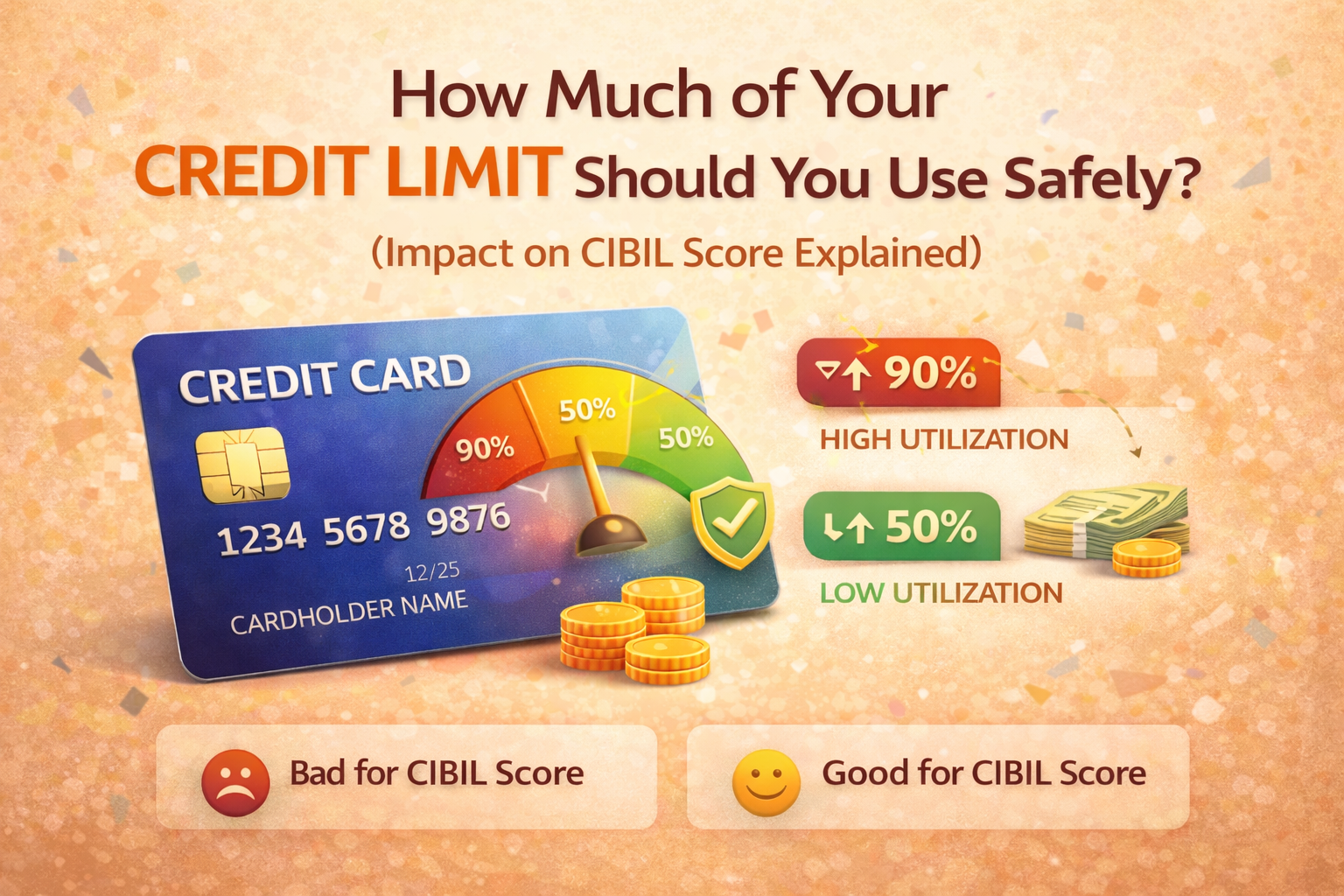
👉 Overall utilization: Below 30%
👉 Per card utilization: Also keep below 30%
|
Usage Level |
Impact |
|
0–30% |
Excellent ✅ |
|
30–50% |
Moderate ⚠️ |
|
50%+ |
Risky ❌ |
📈 How It Affects Your CIBIL Score
Your TransUnion CIBIL score considers:
✅ Positive Signals:
- Low overall usage
- Balanced usage across cards
❌ Negative Signals:
- High usage on one card
- Frequently maxing out limits
💎 Real-Life Scenario
You have 3 cards:
- HDFC Bank → ₹1,00,000 limit, ₹80,000 used
- ICICI Bank → ₹50,000 limit, ₹5,000 used
- Axis Bank → ₹50,000 limit, ₹5,000 used
👉 Total limit = ₹2,00,000
👉 Total usage = ₹90,000 (45%)
👉 Overall = Moderate ⚠️
👉 But one card at 80% = Negative impact ❌
⚠️ Common Mistakes
- Using one card fully while others are idle
- Ignoring overall utilization
- Thinking, “I’ll pay later, so it doesn’t matter.”
Most people don’t know this trick:
Banks report your balances to CIBIL before your payment date, so high usage gets recorded even if you pay on time.
💡 Smart Ways to Manage Multiple Cards
✅ Practical Tips:
- Spread expenses across cards
- Keep each card below 30% usage
- Pay part of the bill before statement generation
- Request the bank to limit the increase to reduce the ratio
📢 Insights
👉 In my opinion:
Having multiple cards is good—but only if you manage utilization smartly.
👉 Here’s a simple hack:
Use one card for daily expenses and keep others as backup to maintain low ratios.
👉 Most people don’t know this:
Even one maxed-out card can pull your score down, despite having unused limits elsewhere.
🔴 Takeaway
To keep your credit score healthy:
👉 Keep total utilization below 30%
👉 Keep each card’s usage below 30%
👉 Avoid maxing out any single card
⭕ Simple rule:
Low usage + smart distribution = Strong CIBIL score
<